

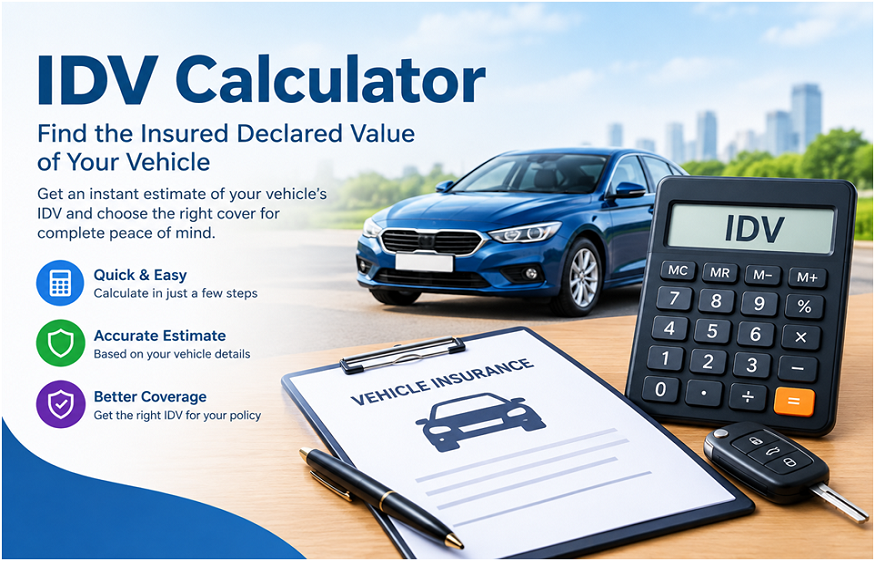
There are two concepts that are mentioned very frequently when talking about car insurance for the first time. These concepts are Insured Declared Value and bumper to bumper cover. A complete guide to the idv calculator will help you understand these concepts better.
What IDV Means in Plain Terms
IDV (Insured Declared Value) is the maximum amount that the insurance company will pay in case your vehicle is stolen or is written off. You can think of IDV as the market value attached to your car by your policy. An idv calculator can help estimate this value based on factors such as the vehicle’s age and depreciation.
This is the market value of your particular model less the depreciation according to the age of the vehicle. A car that originally costs ₹10 lakh will not have an IDV of ₹10 lakh two years down the line because of the effect of age on the IDV formula.
Walking Through the Calculation
Begin by gathering three bits of information, all three of which must be taken from your registration certificate and not remembered.
The exact model you have, as there can be great variations between the same model in terms of listed price depending on the trim level. The registration date of the car, as it establishes its exact age. And the fuel that you use, as it affects the valuation of some components.
When IDV Actually Matters
That is where a lot of first-time buyers get it wrong. When making an insurance claim in an accident where there is damage to your car but your car can be repaired, IDV is not very relevant. IDV only has meaning in two cases: one is when your car gets stolen and another is when repair cost exceeds about 75% of the declared value.
The insurer then considers your car to be a total loss and pays you the declared value.
Read More: What Rural Buyers Should Know About VIP 0001 Number Plate Prices and Parivahan Registration
Should You Adjust It?
In most cases, there is room for changing the figure to either an upper or a lower side within certain acceptable parameters. Increasing it raises both your cost and your maximum coverage. Reducing it lowers both.
It is a usual tendency to reduce it in order to reduce expenses. It works out yearly and fails one time when the loss occurs, as it will be impossible to bridge the difference between your payment and the cost of replacement yourself.
The reverse process of increasing it to a higher level than the calculated one also fails, since settlements always consider the market value of the car at the moment of the accident.
For most first-time car buyers, keeping it near the calculated one is the right thing to do.
Why Bumper-to-Bumper Costs More
The other phrase is equally confusing. Bumper to bumper insurance, otherwise referred to as zero depreciation cover, affects the way claims are handled under a normal insurance contract.
Under normal insurance terms, where depreciation is involved during replacement of damaged parts, the insurer will apply the depreciation on that particular part. Therefore, if a plastic bumper is to be replaced on a car that is three years old, there is depreciation which is paid by the policyholder. As the age of the car increases, so does the percentage that must be paid.
The bumper to bumper cover eliminates all these depreciation deductions.
The Cost Difference Explained
The higher premium is easy to understand once the process is understood. In this case, the insurance company will be offering to pay for some of the claims on repairs. This means that there is indeed a transfer of costs, which means there is a price to be paid.
The only determinant of whether it is worthwhile or not is the age of the car. If it is a new car, where repairs are mostly done by replacing the components and not repairing them, then it usually works out to be worthwhile in just one major repair claim.
For the old car, it is rarely offered by the insurance companies, even when it is offered, it is less worthwhile.
How the Two Interact
However, they handle different claim situations. IDV handles the situations of theft and total loss whereas bumper-to-bumper handles repair claims.
To ensure both situations are handled appropriately, there should be a setting of a realistic value for the car together with the purchase of a bumper-to-bumper policy for a new car. It is an inappropriate exchange to have a low value for your car just so as to get a bumper-to-bumper policy.
Read More: Is the Hyundai Venue fuel efficient for daily Indian driving?
What to Do as a First-Time Buyer
Take your registration card and identify the variant, the registration year, and the fuel used. Use these factors for calculating the IDV using a calculator. After getting quotes, calculate the declared value of each insurance company against your IDV before analyzing premiums.
If it is a new car, then evaluate the cost of bumper-to-bumper cover as an optional policy and analyze the premium cost in comparison to a bumper or panel repair cost per year. In most cases, this will be economically viable.