
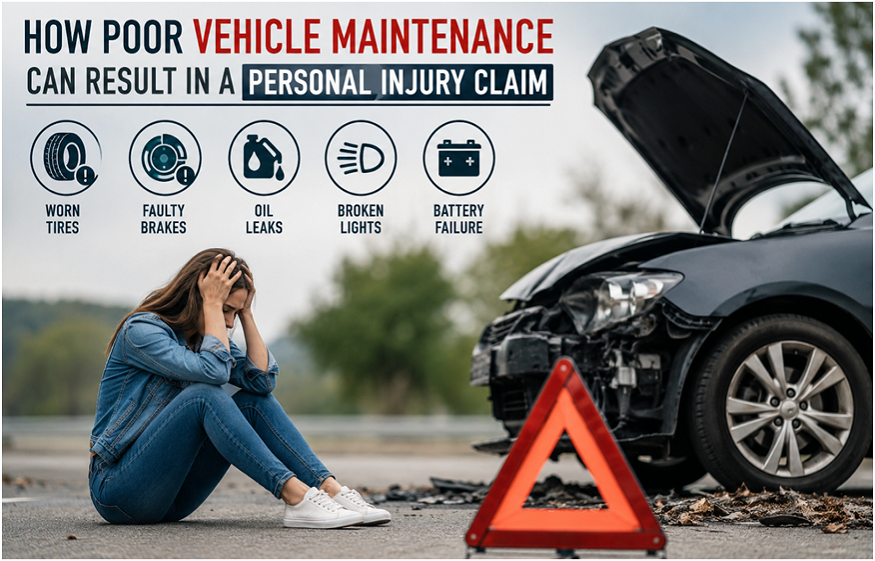
Most car accidents are associated with driver behavior – speeding, distraction, impairment, or failure to follow traffic laws. But sometimes the immediate cause of a crash is mechanical: brakes that no longer stop effectively, tires with dangerously worn tread, a steering component that fails, or lights that have not worked for weeks.
When a vehicle owner or driver knows – or reasonably should know – that a vehicle has a safety problem and fails to address it, poor vehicle maintenance can potentially become the basis for a personal injury claim if that condition contributes to a crash and causes someone to be injured. Drivers and vehicle owners are generally expected to take reasonable steps to keep vehicles safe for use on public roads, although the specific legal duties and standards vary by state.
The important issue is usually not simply whether a vehicle needed maintenance. A personal injury claim generally requires a connection between the neglected condition, the accident, and the resulting injuries.
How Can Poor Vehicle Maintenance Cause an Accident?
Vehicles contain thousands of components that must work together safely. Many mechanical problems develop gradually rather than appearing without warning.
Brake pads wear down. Tire tread disappears. Windshield wipers deteriorate. Headlights burn out. Steering and suspension components become loose or damaged. Warning lights may signal developing problems.
Ignoring these issues can eventually make it more difficult – or impossible – for a driver to control the vehicle safely.
For example, worn brake components may increase stopping distance, while bald or improperly maintained tires can reduce traction, especially during wet or slippery conditions. Broken brake lights may prevent a following motorist from recognizing that a vehicle is slowing.
NHTSA emphasizes the safety importance of tire condition and recommends regular inspections of tire pressure, tread, sidewalls, and other signs of damage. The agency states that tires should be replaced when tread reaches 2/32 of an inch and notes that adequate tread provides traction that helps prevent slipping and sliding, particularly on wet or icy roads.
What Maintenance Problems Commonly Contribute to Crashes?
Almost any safety-critical component can become relevant if inadequate maintenance allows it to deteriorate.
Some of the more common examples include:
Worn or Failing Brakes
A driver approaching stopped traffic may press the brake pedal only to discover that the vehicle cannot stop as quickly as expected.
Brake-related problems can involve worn pads or rotors, deteriorated hoses, leaking brake fluid, malfunctioning components, or other conditions affecting braking performance.
If there were warning signs before the crash – such as grinding sounds, a soft brake pedal, increased stopping distance, dashboard warnings, or a mechanic’s prior recommendation for repairs – those facts may become important when determining whether the problem reasonably should have been addressed.
Bald, Damaged, or Improperly Inflated Tires
Tires are the vehicle’s primary point of contact with the road. Their condition can directly affect braking, steering, traction, and stability.
Potential problems include:
- Excessively worn tread
- Underinflation or overinflation
- Sidewall damage
- Bulges or cracks
- Uneven wear
- Improperly repaired punctures
- Failure to replace aging or damaged tires
NHTSA recommends checking tire pressure and tread regularly and inspecting tires for cuts, punctures, bulges, scrapes, cracks, and other signs of damage.
A worn tire that loses traction during heavy rain, for example, could cause a vehicle to hydroplane and leave its lane.
Broken Headlights, Taillights, and Brake Lights
Vehicle lighting does more than allow a driver to see at night. It also helps other road users understand what the vehicle is doing.
A burned-out brake light can make it harder for a following driver to realize that traffic is slowing. Defective headlights can reduce visibility at night, while malfunctioning turn signals can prevent other motorists from anticipating a turn or lane change.
NHTSA’s federal vehicle safety standards address a broad range of components, including lighting, brakes, and windshield wipers, reflecting the importance of these systems to vehicle safety.
Steering and Suspension Problems
Worn steering or suspension components can affect how a vehicle responds to driver input and how well it remains stable during turns, braking, or emergency maneuvers.
Problems could include loose steering components, damaged tie rods, failing ball joints, worn wheel bearings, or deteriorated suspension parts.
In severe cases, a component failure could cause a driver to lose control altogether.
Windshield Wipers and Visibility Problems
Something as simple as worn windshield wiper blades can create a dangerous situation during heavy rain or snow.
If a driver cannot adequately see the roadway, pedestrians, traffic signals, lane markings, or other vehicles, the risk of a collision increases. A malfunctioning defroster or other visibility-related problem could create similar concerns.
Unaddressed Warning Lights and Mechanical Symptoms
Modern vehicles provide numerous warnings when something may be wrong.
A dashboard warning light does not necessarily mean that a crash is imminent. But repeatedly ignoring a known safety-related problem can become relevant if that same problem later contributes to an accident.
Similarly, unusual noises, vibrations, pulling while braking, steering difficulties, or repeated loss of tire pressure may indicate a condition requiring inspection.
When Can Poor Maintenance Become Negligence?
A mechanical failure alone does not necessarily prove that the vehicle owner was negligent.
Cars can sometimes experience unexpected failures even when they have been reasonably maintained. The key question is often whether a person knew or reasonably should have known about an unsafe condition and failed to take reasonable action. Legal standards vary among jurisdictions, but inadequate maintenance can support liability when a preventable mechanical problem contributes to a collision.
Consider two different scenarios.
In the first, a driver’s brakes suddenly fail because of an internal component defect that could not reasonably have been detected through ordinary maintenance. The driver may have had no warning that anything was wrong.
In the second, the brakes have been grinding for months, the vehicle takes increasingly longer to stop, and a repair shop previously told the owner that the brakes needed immediate replacement. The owner continues driving without repairing them, and the vehicle later rear-ends another car because it cannot stop in time.
Those circumstances present very different questions about reasonable care.
What Must Generally Be Proven in a Maintenance-Related Personal Injury Claim?
Although personal injury laws vary by jurisdiction, negligence claims commonly involve several basic concepts.
A Duty of Reasonable Care
The person responsible for operating or maintaining the vehicle must have owed a legal duty to exercise reasonable care.
A Breach of That Duty
Evidence must indicate that the person failed to act reasonably under the circumstances – for example, by continuing to operate a vehicle despite knowing about dangerously worn brakes.
Causation
The maintenance failure must have contributed to causing the accident and injuries.
This element is critical. Discovering that a car had bald tires does not automatically establish liability if the crash had nothing to do with traction or tire performance.
Damages
The accident must have resulted in legally recognizable harm, such as physical injuries, medical expenses, lost income, or other compensable losses.
Negligence is a foundational concept in many personal injury claims, but how each element is defined and proved depends on applicable state law.
How Do You Prove That Poor Maintenance Caused the Crash?
Maintenance-related accidents can be more complicated to investigate than crashes caused by an obvious traffic violation.
A driver running a red light may be captured on video. A worn brake component or failed steering part may require a detailed mechanical inspection.
Potentially useful evidence can include:
- Maintenance records
- Repair invoices and estimates
- Vehicle inspection records
- Service recommendations that were declined
- Tire purchase and replacement records
- Photographs of damaged or worn components
- Dashboard warning-light information
- Vehicle diagnostic data
- The vehicle owner’s statements
- Witness testimony
- Accident-scene photographs
- Surveillance or dashcam footage
- Police reports
- Expert vehicle inspections
- Accident reconstruction evidence
The damaged vehicle itself may also become important physical evidence.
A qualified expert may be able to inspect brake components, tires, steering systems, suspension parts, or other equipment to determine whether a mechanical problem existed and whether it contributed to the collision. Mechanical defects, including brake, tire, and suspension conditions, are among the vehicle factors examined during detailed crash investigations.
Why the Vehicle Should Be Preserved After a Suspected Mechanical Failure
If poor maintenance or mechanical failure may have contributed to a serious accident, repairing, selling, scrapping, or otherwise altering the vehicle too quickly could destroy important evidence.
For example, replacing all four tires before an inspection could eliminate evidence showing how worn they were at the time of the collision. Repairing the brakes might make it more difficult to determine what caused them to malfunction.
Preserving the vehicle can allow qualified experts for the interested parties to inspect the components involved and document their condition.
Evidence-preservation rules vary, but parties who reasonably anticipate litigation may have obligations to preserve relevant evidence. That makes early identification of a potential mechanical issue particularly important.
Can the Vehicle Owner Be Liable Even If Someone Else Was Driving?
Potentially.
Ownership, operation, maintenance responsibility, permission to use the vehicle, and applicable state law can all affect liability.
For example, an owner who allows another person to drive a vehicle despite knowing that its brakes are unsafe could potentially face different legal issues than an owner who had no reason to know about a hidden mechanical problem.
The specific rules governing owner liability differ significantly among jurisdictions, so there is no universal rule that makes every vehicle owner automatically responsible whenever poor maintenance contributes to a crash.
What If a Repair Shop Caused the Mechanical Problem?
Sometimes a crash occurs not because the owner ignored maintenance but because maintenance or repairs were performed incorrectly.
For example, potential issues could involve:
- Improperly installed brakes
- Loose wheels after tire service
- Incorrect repairs to steering components
- Failure to properly secure parts
- Installation of an inappropriate component
- Failure to identify or communicate a dangerous condition within the scope of an inspection or repair
Depending on the facts and applicable law, a repair facility may potentially face liability when negligent work contributes to a later crash. The analysis can depend on the scope of work the shop agreed to perform, what it discovered, what repairs were completed, and whether appropriate warnings were provided.
That means an investigation into a maintenance-related crash may need to examine more than the actions of the driver.
What If the Problem Was a Defective Vehicle Part?
Poor maintenance and defective products are not the same thing.
Suppose a driver regularly services the vehicle and replaces the brakes as recommended, but a newly installed brake component contains a manufacturing defect and unexpectedly fails.
In that situation, the focus may shift away from maintenance and toward whether the vehicle, replacement component, manufacturer, distributor, installer, or another party was responsible for the defect.
NHTSA maintains recall information for vehicles and equipment with identified safety problems, and manufacturers have obligations under federal law relating to safety-related defects and recalls.
Determining whether a failure resulted from wear, inadequate maintenance, improper repair, or a defective component can therefore be an important part of investigating the claim.
Read More: Hob Resharpening Tools: Guide to Shaving Cutters Resharpening
Commercial Vehicles Can Raise Additional Maintenance Questions
Poor maintenance can become especially serious when the vehicle is operated as part of a business or commercial fleet.
Commercial trucks, delivery vehicles, buses, vans, rideshare vehicles, and other heavily used vehicles may accumulate mileage much faster than a typical personal automobile.
When a commercial vehicle is involved, an investigation may examine issues such as:
- Company inspection procedures
- Maintenance schedules
- Repair records
- Driver inspection reports
- Previously reported mechanical problems
- Whether recommended repairs were delayed
- Who was responsible for approving maintenance
- Whether the vehicle remained in service despite known safety concerns
Depending on the circumstances, responsibility might involve the driver, vehicle owner, employer, fleet operator, maintenance provider, or another entity.
Can an Injured Driver’s Own Poor Maintenance Affect a Claim?
Yes, potentially.
Poor vehicle maintenance is not only an issue for the person accused of causing an accident.
Imagine that another motorist makes an unsafe lane change, but the injured driver’s extremely worn tires also contribute to the loss of control. Depending on the jurisdiction and evidence, the condition of the injured person’s own vehicle could become part of the liability analysis.
Many states have comparative or contributory fault rules that can affect recovery when more than one person’s conduct contributes to an accident. The details vary considerably by state.
Therefore, maintenance records may sometimes be relevant to vehicles on both sides of a collision.
What Damages May Be Available After a Maintenance-Related Accident?
When negligent vehicle maintenance causes an accident, the categories of damages potentially available are generally similar to those involved in other motor vehicle injury claims.
Depending on applicable law and the circumstances, they could include compensation for:
- Emergency medical treatment
- Hospital bills
- Surgery
- Rehabilitation and physical therapy
- Future medical care
- Lost wages
- Reduced earning capacity
- Pain and suffering
- Permanent disability
- Scarring or disfigurement
- Property damage
The damages available and how they are calculated vary by jurisdiction and individual case.
Read More: Truck Wash Detergent Buying Guide: What Fleet Managers Need to Know
Routine Maintenance Is About More Than Protecting the Vehicle
Oil changes, tire inspections, brake service, lighting checks, and other routine maintenance are often viewed primarily as ways to prevent breakdowns and extend a vehicle’s lifespan.
They are also safety measures.
NHTSA recommends regular vehicle and tire inspections and encourages motorists to address worn or damaged parts that could compromise safe operation.
A person does not have to predict every unexpected mechanical failure. But knowingly operating a vehicle with a serious safety problem can put passengers, other drivers, bicyclists, pedestrians, and everyone else on the road at risk.
The Bottom Line: Neglected Vehicle Maintenance Can Create Personal Injury Liability
Poor vehicle maintenance can result in a personal injury claim when an unsafe mechanical condition contributes to an accident and the evidence shows that the responsible person failed to use reasonable care.
Worn brakes, bald tires, broken lights, steering problems, damaged suspension components, and other neglected safety issues can interfere with a driver’s ability to stop, steer, maintain traction, or safely communicate with other motorists.
However, the existence of a mechanical problem does not automatically establish negligence. A thorough investigation may need to determine what failed, why it failed, whether warning signs existed, who was responsible for maintaining the vehicle, and whether that failure actually caused or contributed to the collision.
In some cases, the responsible party may be the driver or vehicle owner. In others, negligent repairs, a defective component, or a company’s inadequate fleet-maintenance practices may introduce additional questions of liability.
Ultimately, maintenance-related personal injury claims illustrate an important principle: road safety depends not only on how people drive their vehicles, but also on whether those vehicles are reasonably safe to drive in the first place.
This article provides general information about vehicle maintenance and personal injury claims and is not legal advice. Negligence, vehicle-owner liability, comparative fault, evidence requirements, and available damages vary by jurisdiction and the circumstances of each case.